
How to Choose a Commercial Flat Roofer in Tulsa, OK
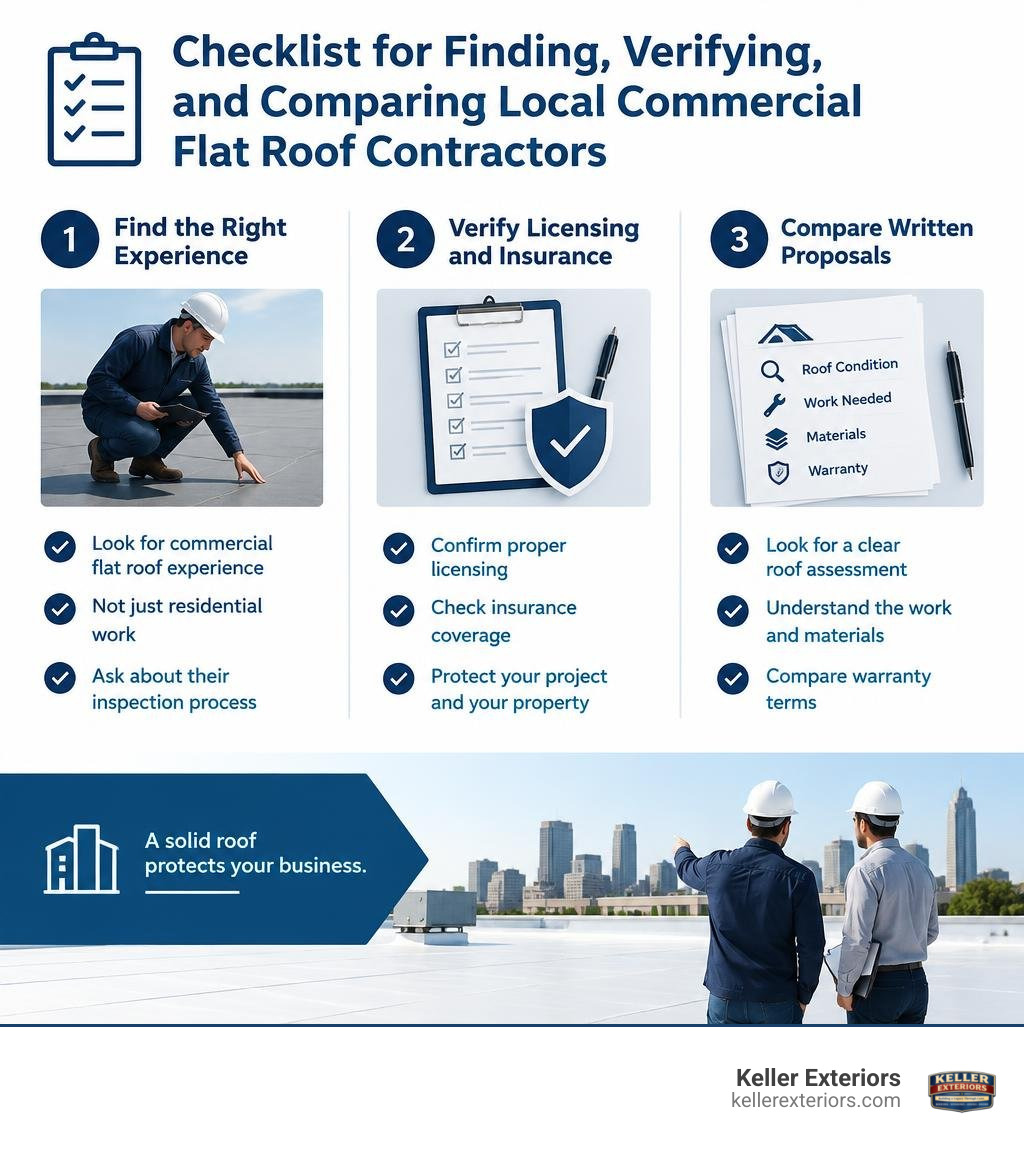
Start with contractors who have experience on commercial flat roofs, not just residential roofs. Ask each one to inspect the membrane, seams, flashing, and drains. Then compare written proposals that explain the roof’s condition, the work needed, the materials, and the warranty. Verify licensing and insurance before you sign.
In Tulsa, OK, storm damage can make a leak urgent. A careful inspection helps you decide whether a targeted repair will work or whether the roof needs a larger fix. When facility managers search for local commercial flat roofing contractors, the primary focus should be local experience, documented safety practices, and a clear plan for keeping the building dry during work.
I’m Robert Keller, owner of Keller Exteriors, and I’ve worked across exterior trades for more than 25 years. When building owners ask how to evaluate commercial roofing teams, I recommend starting with the checks in this guide.
Finding Top Local Commercial Flat Roofing Contractors in the Tulsa Area
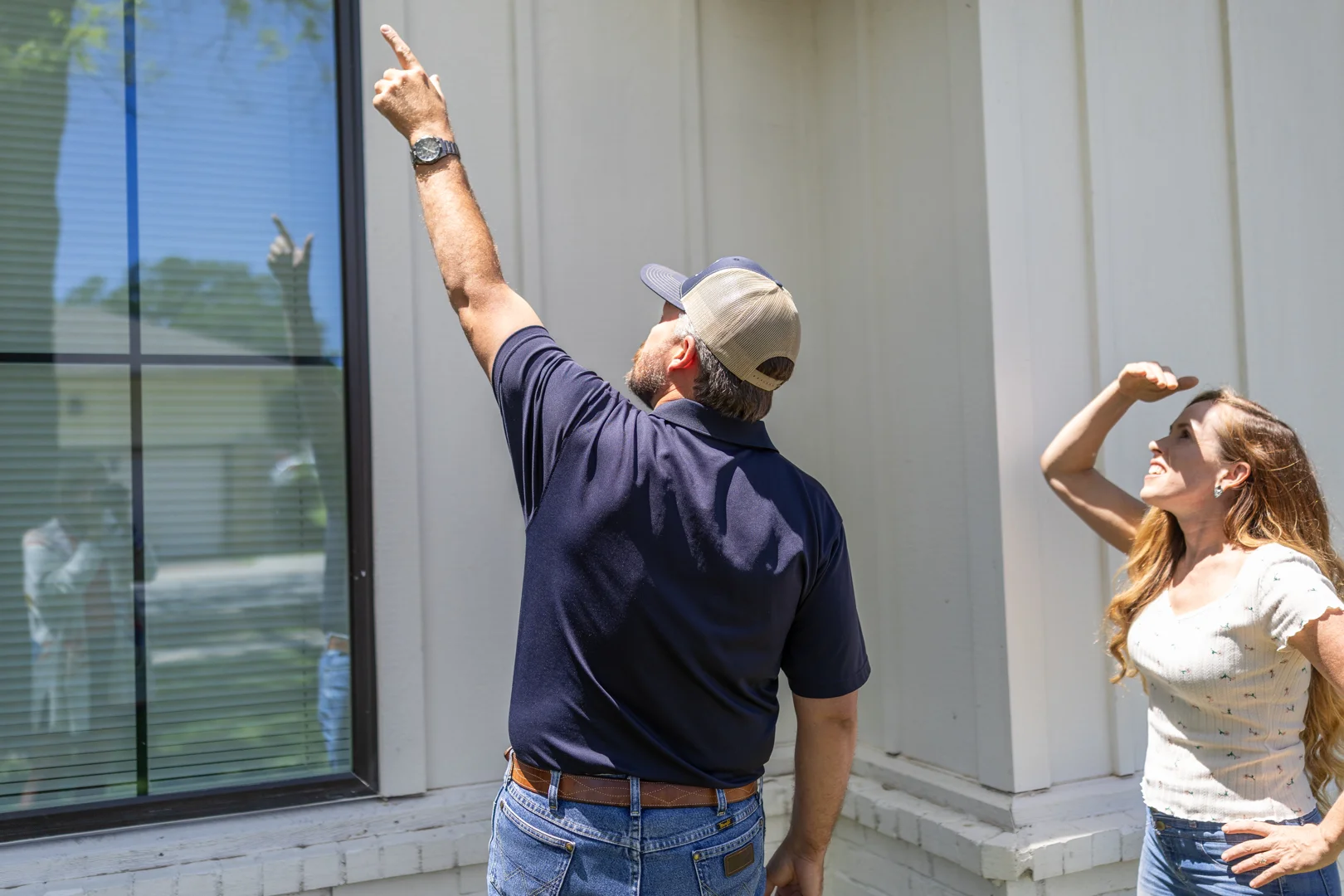
Finding a dependable crew to handle your building envelope requires looking beyond a standard internet search. A commercial low-slope roof is a complex engineered assembly that supports rooftop HVAC units, heavy foot traffic, and sophisticated drainage networks. When you manage a facility in Broken Arrow, OK, Owasso, OK, or Jenks, OK, working with a team experienced in commercial roofing ensures your building stays fully protected from structural leaks and operational downtime.
Commercial properties face distinct challenges that residential roofs never encounter. Flat assemblies handle continuous standing water after rainfall, building expansion and contraction, and chemical exhaust from manufacturing or kitchen vents. Choosing a partner with local knowledge ensures your roof system meets local building codes and withstands intense regional weather patterns.
Why Searching for Local Commercial Flat Roofing Contractors Requires Local Verification
Regional weather conditions in Northeastern Oklahoma are tough on flat roof assemblies. High summer heat with intense UV exposure, sudden spring hail events, and winter freeze-thaw cycles place severe physical stress on roof membranes and perimeter flashings. High wind gusts across open areas in Bixby, OK, Sand Springs, OK, and Claremore, OK can lift unadhered roof edges or rip loose fasteners if the original installation skipped critical details.
When vetting local commercial contractors, look for:
- A proven portfolio of completed commercial projects in the immediate metropolitan area.
- Direct experience designing systems that meet regional wind uplift requirements.
- Familiarity with municipal permitting standards in cities like Bartlesville, OK, Collinsville, OK, and Coweta, OK.
- Verifiable local references from property managers, warehouse operators, and commercial building owners.
A contractor based outside your market may not understand how rapid temperature shifts cause thermal shock in single-ply membranes. Verifying a contractor’s local standing confirms they will be available for prompt warranty service, routine inspections, and long-term support.
Verifying Commercial Licenses, General Liability, and Safety Compliance
Commercial low-slope projects carry significant operational risk. Working around heavy equipment, dealing with open flame or hot air welders, and handling large membrane rolls require rigorous safety standards. Never allow an unverified contractor on your commercial roof.
Ensure any candidate provides:
- Valid state contractor registration and licensing specific to commercial construction.
- Comprehensive general liability insurance that explicitly covers commercial roofing operations.
- Full workers’ compensation coverage for every crew member on site.
- An established safety program that follows standard OSHA safety protocols.
- Active bonding capacity matched to your project scope.
Verifying safety records protects your business from third-party liability if an accident occurs on your property. Legitimate commercial roofers readily provide certificates of insurance directly from their insurance carrier with your facility named as an additional insured party.
Commercial Flat Roofing Systems: Comparing Materials, Costs, and Lifespans
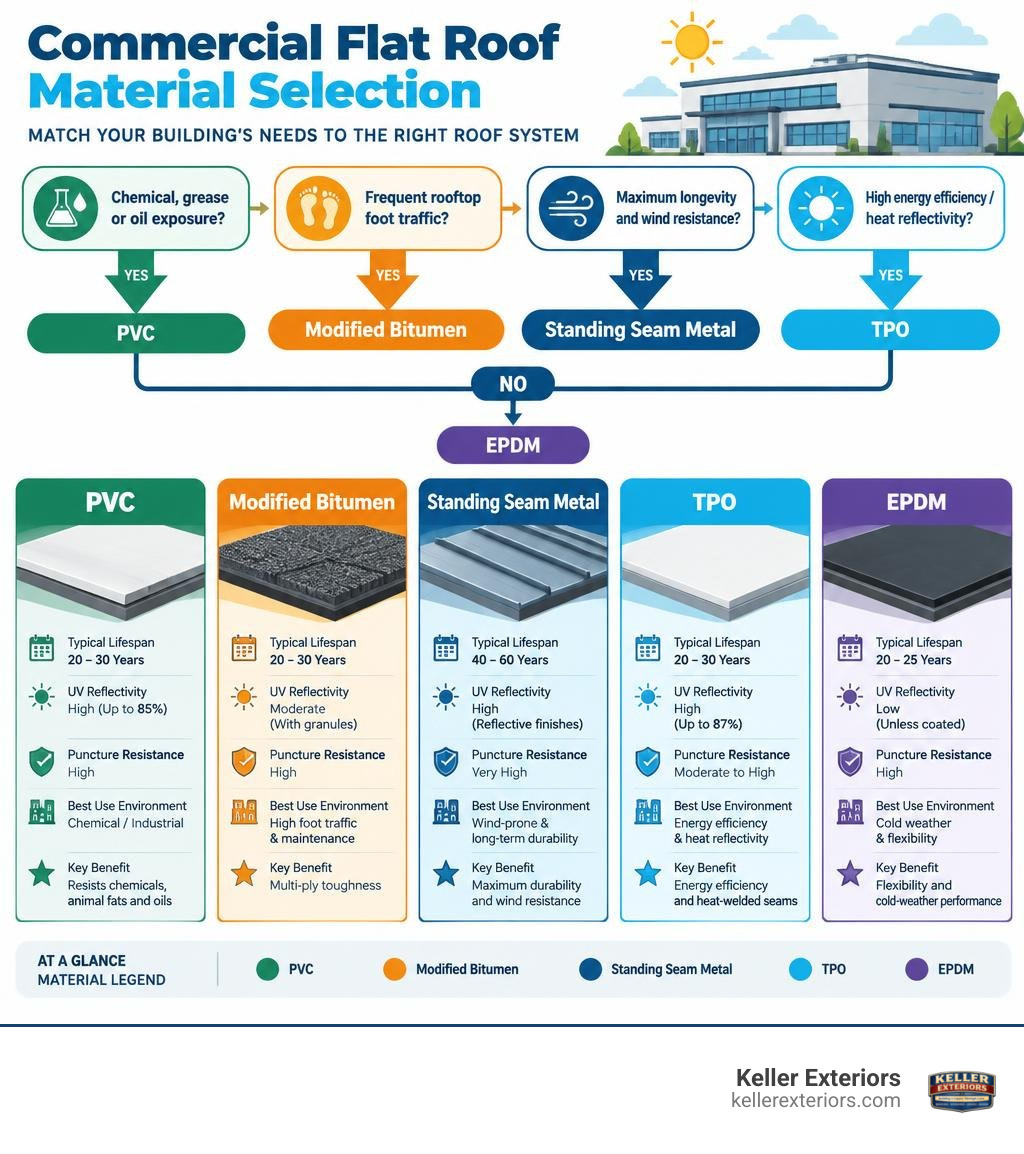
Selecting the right commercial roof system depends on your building structure, rooftop foot traffic, chemical exposure, and operational budget. Each system offers distinct advantages depending on whether you manage a retail store in Glenpool, OK, an industrial warehouse in Catoosa, OK, or a medical clinic in Pryor, OK.
| Roofing System | Typical Lifespan | UV Reflectivity | Puncture Resistance | Primary Benefit |
|---|---|---|---|---|
| TPO (Thermoplastic Polyolefin) | 20 to 30 Years | High (Up to 87%) | Moderate to High | Excellent energy efficiency and heat-welded seam strength |
| EPDM (Rubber) | 20 to 25 Years | Low (Unless coated) | High | Exceptional flexibility and cold-weather performance |
| PVC (Polyvinyl Chloride) | 20 to 30 Years | High (Up to 85%) | High | Outstanding resistance to chemicals, animal fats, and oils |
| Modified Bitumen | 20 to 30 Years | Moderate (With granules) | High | Multi-ply toughness against heavy foot traffic |
| Standing Seam Metal | 40 to 60 Years | High (Reflective finishes) | Very High | Maximum long-term durability and wind uplift resistance |
Single-Ply Membranes: TPO, EPDM, and PVC Performance
Single-ply membranes are widely used across modern commercial properties because they provide lightweight, reliable water protection.
- TPO (Thermoplastic Polyolefin): TPO is one of the most common commercial roofing choices. Its bright white surface reflects solar heat, which helps lower interior cooling costs during hot Oklahoma summers. The seams are hot-air welded together, creating a physical bond stronger than the membrane itself. For a closer look at material tradeoffs, the commercial roofing systems comparison explains where TPO, EPDM, and PVC fit different commercial applications.
- EPDM (Ethylene Propylene Diene Monomer): EPDM is a durable synthetic rubber membrane known for long-term weather resistance. It remains flexible in freezing temperatures and resists hail impacts effectively. While traditionally black, it can be paired with reflective coatings to improve thermal performance.
- PVC (Polyvinyl Chloride): PVC is engineered for harsh commercial environments. If your facility houses restaurants, food processing equipment, or manufacturing exhausts, PVC provides superior resistance to grease, oils, and industrial chemicals while delivering strong fire-resistant performance.
According to the U.S. Department of Energy, installing cool roof surfaces with high solar reflectance can significantly reduce building energy demand during peak cooling hours, making reflective white membranes an effective choice for facility managers.
Modified Bitumen, Built-Up Roofing, and Metal Alternatives
Traditional multi-ply systems and metal solutions provide exceptional durability for facilities with unique operational demands:
- Modified Bitumen & Built-Up Roofing (BUR): These systems use multiple layers of asphalt-saturated felts or polymer-modified sheets covered with gravel or mineral granules. The multi-ply construction offers superior resistance to rooftop punctures, making it an excellent option for buildings with frequent maintenance crews servicing HVAC units.
- Commercial Metal Roofing: For low-slope structures that can support structural panels, commercial metal roofing provides unmatched longevity. Standing seam metal systems last 40 to 60 years, handle winds up to 140 mph, and require minimal routine maintenance over their service life.
Commercial Flat Roof Repair vs. Replacement: Knowing When to Act
Deciding whether to repair, restore, or replace an aging commercial roof is a major financial decision. A premature replacement wastes valuable capital, while delaying a needed replacement can lead to rotted roof decking, ruined insulation, and damaged tenant inventory.
Immediate Warning Signs of Commercial Flat Roof Damage
Watch for these clear signs that your commercial flat roof requires professional attention:
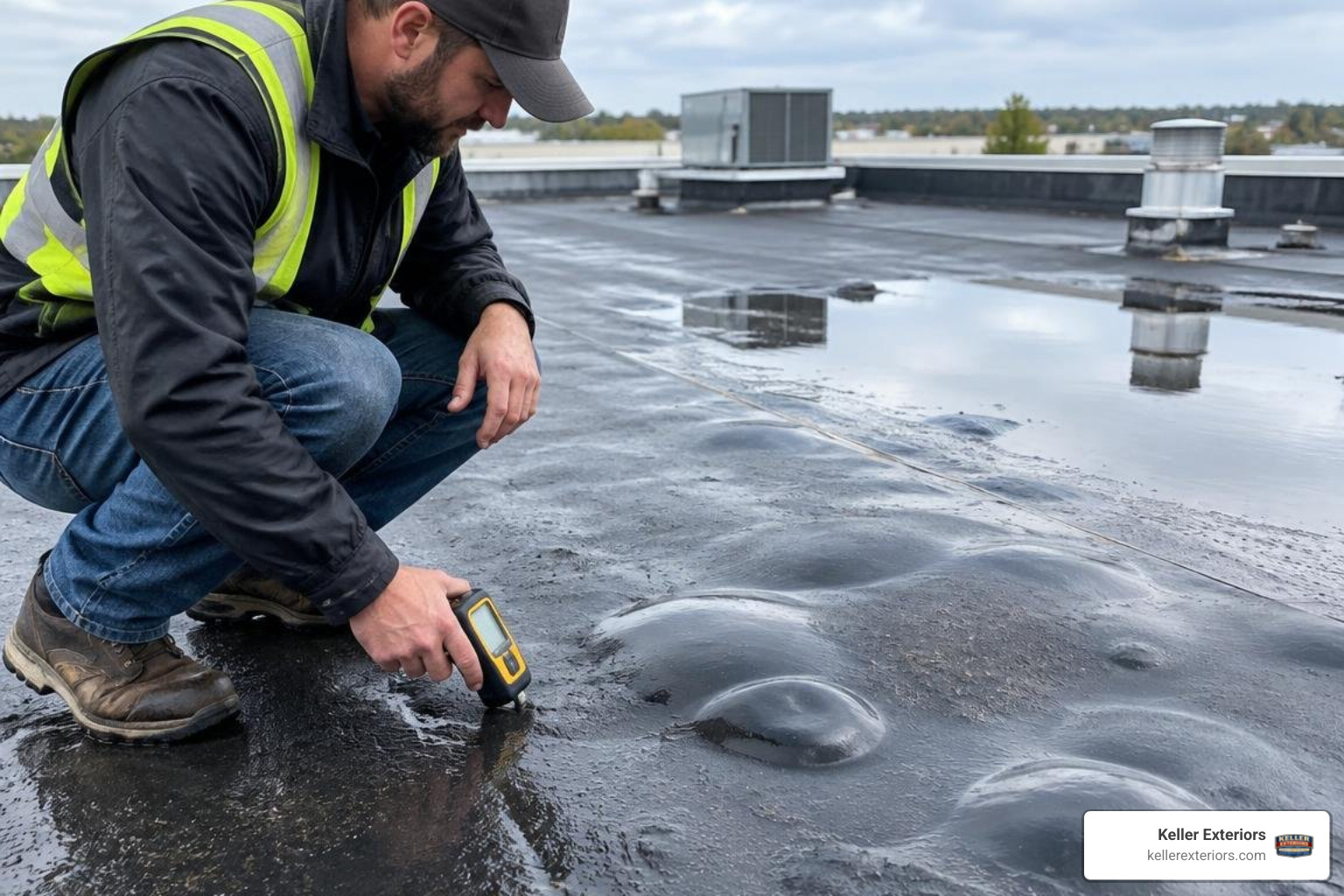
- Ponding Water: Standing water that remains on the roof surface 48 hours after rain indicates poor drainage or compressed insulation.
- Membrane Blisters and Cracking: Bubbles in single-ply membranes or alligatoring on asphalt surfaces show that trapped moisture or UV degradation is breaking down the material.
- Separated Seams and Flashing Gaps: Failed adhesive or cracked sealants around parapet walls, skylights, and rooftop pipes create open paths for water intrusion.
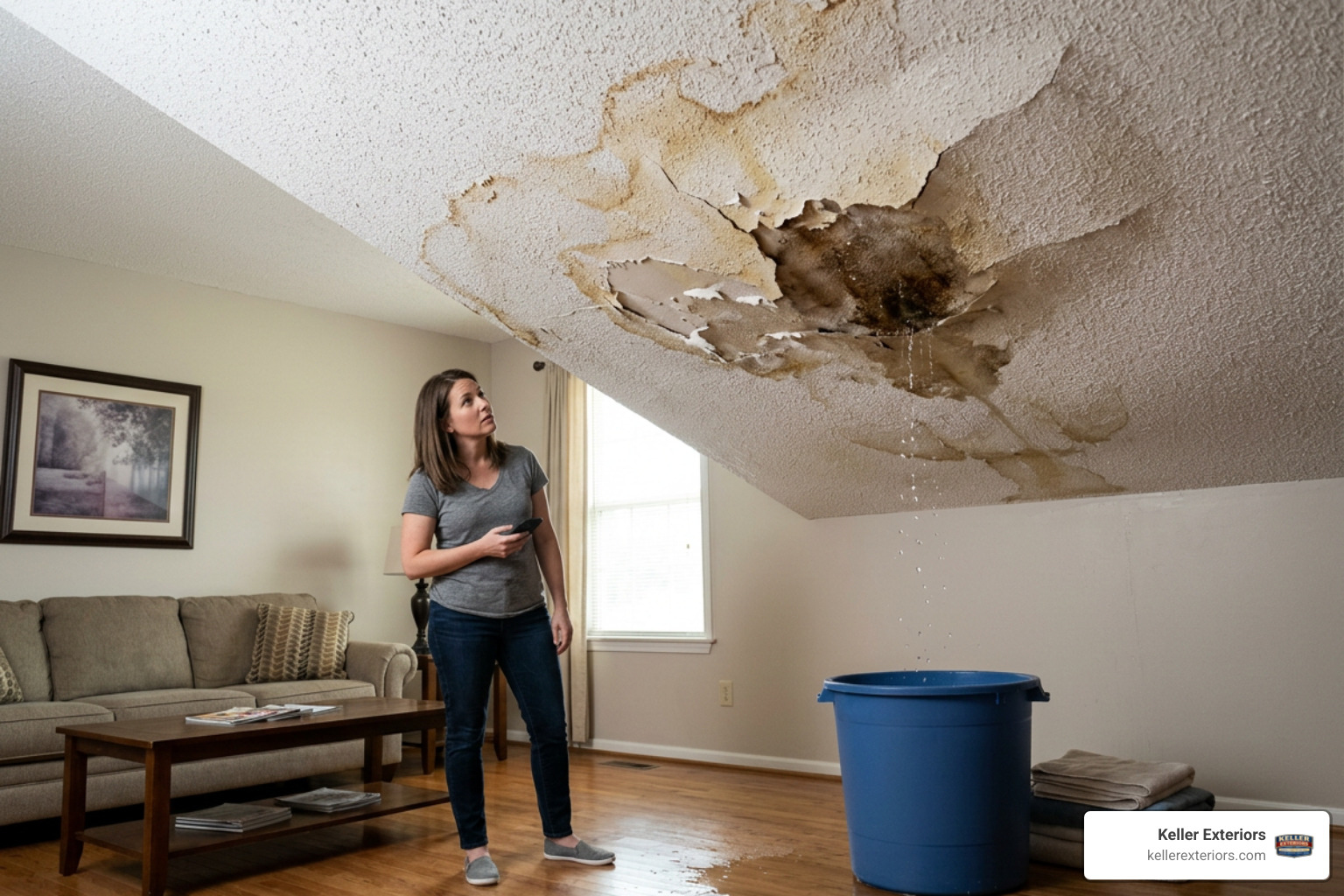
- Interior Ceiling Stains or Odors: Water stains on ceiling tiles, rusted structural purlins, or musty smells in offices mean moisture has already penetrated the roof deck.
If severe weather strikes your building in Forest Ridge, OK or Stone Canyon, OK, promptly schedule storm damage assessments to document damage for insurance before water migrates deeper into the building. For active leaks that threaten business continuity, our team provides rapid emergency roof repair to stabilize your facility.
Calculating Cost Thresholds and Core Moisture Assessments
Before deciding to tear off a commercial roof, a thorough diagnostic assessment must be completed. A reputable contractor uses non-destructive moisture surveys and physical core samples to evaluate what lies beneath the membrane. When an active leak develops during a storm, the steps in our emergency roof leak guide can help facilities limit interior damage while arranging professional service.
When evaluating your options:
- Infrared Thermal Imaging: Scans performed during cool evenings reveal hidden moisture pockets trapped within the insulation board.
- Core Sampling: Taking a physical cross-section of the roof assembly verifies the existing number of roof layers, deck condition, and insulation integrity.
- The 25% Rule: If non-destructive testing reveals that more than 20% to 25% of the underlying insulation is wet, a targeted patch will no longer provide a long-term fix.
- Municipal Building Codes: Most local building codes allow a maximum of two roofing layers. If your building already has two systems in place, adding another overlay is prohibited, and a complete tear-off is mandatory.
When minor seam failures or puncture issues are caught early, targeted repairs can successfully extend the system’s service life. However, when recurring leaks happen across multiple zones, reviewing roof replacement options can help facility managers weigh a full replacement against continued repairs.
Essential Vetting Standards for Commercial Roofers
Selecting the right commercial contractor involves evaluating their production capabilities, communication standards, and project sequencing. A high-quality commercial team works cleanly and plans each stage of work to minimize interruptions to your daily operations.
Key Questions to Ask Local Commercial Flat Roofing Contractors Before Signing
Ask these practical questions before executing any commercial roofing contract:
- Who will supervise the daily work on site? Ensure there is a designated, English-speaking project manager on the roof at all times.
- Do you employ your own trained crews, or do you subcontract the entire project? In-house crews deliver more consistent installation quality and adherence to safety guidelines.
- What is your detailed plan for protecting our building interior and property? Ask how they manage tear-off debris, protect rooftop HVAC equipment, and prevent water intrusion during overnight shifts.
- How do you handle unforeseen deck rot or deteriorated insulation? The contract must specify unit pricing for replacing damaged decking and wet polyiso insulation boards.
- Can you accommodate flexible staging to keep our business open? Commercial installations often require phased tear-offs, weekend shifts, or early-morning crane staging to keep parking lots clear.
Understanding Manufacturer NDL Warranties and Workmanship Guarantees
Commercial roofing warranties fall into two distinct categories:
- Workmanship Warranties: Provided directly by the roofing contractor, this guarantee covers errors during the installation process, flashing assembly, and site details.
- Manufacturer No Dollar Limit (NDL) Warranties: Issued directly by the membrane manufacturer, an NDL warranty covers both material defects and labor costs for approved repairs during the warranty period, with no cap on repair expenses.
To provide an NDL warranty, a contractor must hold master-level certification with the manufacturer. Achieving this certification requires passing regular third-party field inspections and demonstrating strict adherence to manufacturer installation guidelines.
Establishing Preventative Maintenance and Inspection Schedules
A commercial flat roof should never be neglected until an interior leak appears. Routine inspections prevent small membrane defects from turning into costly structural repairs.
Best practices for commercial roof asset management include:
- Scheduling semi-annual inspections in the spring and fall.
- Clearing roof drains, scuppers, and internal downspouts of debris to avoid standing water.
- Inspecting expansion joints and pitch pans around HVAC electrical lines annually.
- Documenting all roof maintenance and repairs to keep manufacturer warranty coverage valid.
Enrolling in structured maintenance plans helps facility managers forecast capital expenses accurately and extend roof lifespans by up to 10 years. The warning signs outlined in how to find a roof leak before it ruins your ceiling can also help facility managers spot concerns before interior damage spreads.
Frequently Asked Questions About Commercial Flat Roofing in Tulsa
How much does commercial flat roof repair or replacement cost?
Commercial flat roof project costs vary widely based on total square footage, membrane type, insulation thickness, building height, and the condition of the underlying deck. Minor spot repairs and localized flashing maintenance generally cost less, while extensive tear-offs with full insulation replacement require a larger investment. Because every building structure has unique access requirements and equipment configurations, obtaining a detailed, on-site professional estimate is always recommended.
How often should a commercial flat roof be inspected in Tulsa?
Commercial roofs in Tulsa should be inspected at least twice a year, ideally in spring and autumn. In addition to scheduled semi-annual inspections, arrange a professional check immediately following severe weather, such as heavy hail storms or high-wind events. Regular maintenance ensures drainage lines remain clear and satisfies the ongoing maintenance requirements of manufacturer NDL warranties.
How long does a commercial flat roof installation take?
Most commercial flat roof installations take between 3 and 10 working days to complete. The overall timeline depends on building square footage, weather conditions, the selected roofing membrane, and whether the project is a single-layer recovery or a complete tear-off down to the structural deck. Experienced commercial contractors plan their work in sections to ensure the building remains fully watertight at the end of each work shift.
What causes ponding water on a flat commercial roof?
Ponding water occurs when a roof lacks adequate slope, has clogged drainage scuppers or internal drains, or has suffered structural sagging due to compressed insulation boards. If water stands on the membrane for more than 48 hours without evaporating or draining, it accelerates membrane degradation and increases the risk of water leaks. Installing tapered polyisocyanurate insulation boards during reroofing resolves persistent drainage problems.
What is the most durable commercial flat roofing material?
Single-ply PVC and modified bitumen systems are exceptionally durable options for high-traffic or chemically demanding environments. PVC resists animal fats, industrial oils, and harsh weather conditions, while modified bitumen provides multi-ply puncture protection against heavy foot traffic. For low-slope structures that can support structural panels, standing seam metal roofs deliver the longest overall service life, often exceeding 50 years.
Can a new flat roof be installed over an existing roof?
Yes, installing a new membrane over an existing roof layer, known as a recover or overlay, is often permissible if the existing assembly has only one layer and the underlying insulation and decking are completely dry. However, building codes limit roofs to a maximum of two layers. If non-destructive testing reveals widespread moisture saturation beneath the existing membrane, a complete tear-off is required.
What is a No Dollar Limit (NDL) commercial roof warranty?
A No Dollar Limit warranty is a manufacturer-backed guarantee that covers 100% of the labor and material costs required to repair covered leaks throughout the warranty term, without any financial cap. To qualify for an NDL warranty, the roof system must be installed by a factory-certified commercial contractor and pass a rigorous quality inspection by a manufacturer technical representative.
How does a white reflective roof help reduce energy costs?
White reflective roofs, commonly installed using TPO, PVC, or bright elastomeric coatings, reflect up to 85% to 87% of solar UV radiation away from the building rather than absorbing it as heat. This lowers roof surface temperatures significantly during hot summer afternoons, reducing the workload on rooftop HVAC systems and cutting electrical utility costs for commercial tenants.
How do I know if my flat roof needs repairs or a full replacement?
If your roof is relatively new and leaks are isolated to damaged flashings, small punctures, or clear seam separations, a professional repair is the most practical choice. If the roof system is approaching the end of its expected lifespan, has recurring leaks across multiple zones, or moisture surveys show more than 25% of the insulation is saturated, a full roof replacement is the more cost-effective long-term solution.
What safety standards should a commercial roofing contractor follow?
A qualified commercial roofing contractor must comply strictly with federal and state OSHA safety guidelines. This includes using dedicated perimeter warning lines, personal fall arrest systems, secure ladder staging, and personal protective equipment. Commercial roofers must also carry valid workers’ compensation and general liability coverage to protect facility owners from jobsite liability.
Securing Long-Term Performance with Keller Exteriors
Commercial flat roofs demand specialized installation techniques, regular maintenance, and skilled craftsmanship. Selecting a roofing partner with local experience ensures your commercial property remains secure, energy-efficient, and code-compliant through every season. Whether your property is located in Tulsa Hills, OK, Midtown, OK, or Brookside, OK, having an experienced team manage your building exterior keeps your business operations running smoothly.
For reliable property protection and dependable commercial craftsmanship, turn to Keller Exteriors to schedule your commercial roof evaluation and discuss our comprehensive roofing solutions.