What You Need to Know Before Choosing a Commercial Roofing System
Commercial roofing systems are one of the most important investments a building owner can make. The right system protects your property, reduces energy costs, and can last decades with proper care. The wrong one leads to leaks, early failures, and expensive repairs.
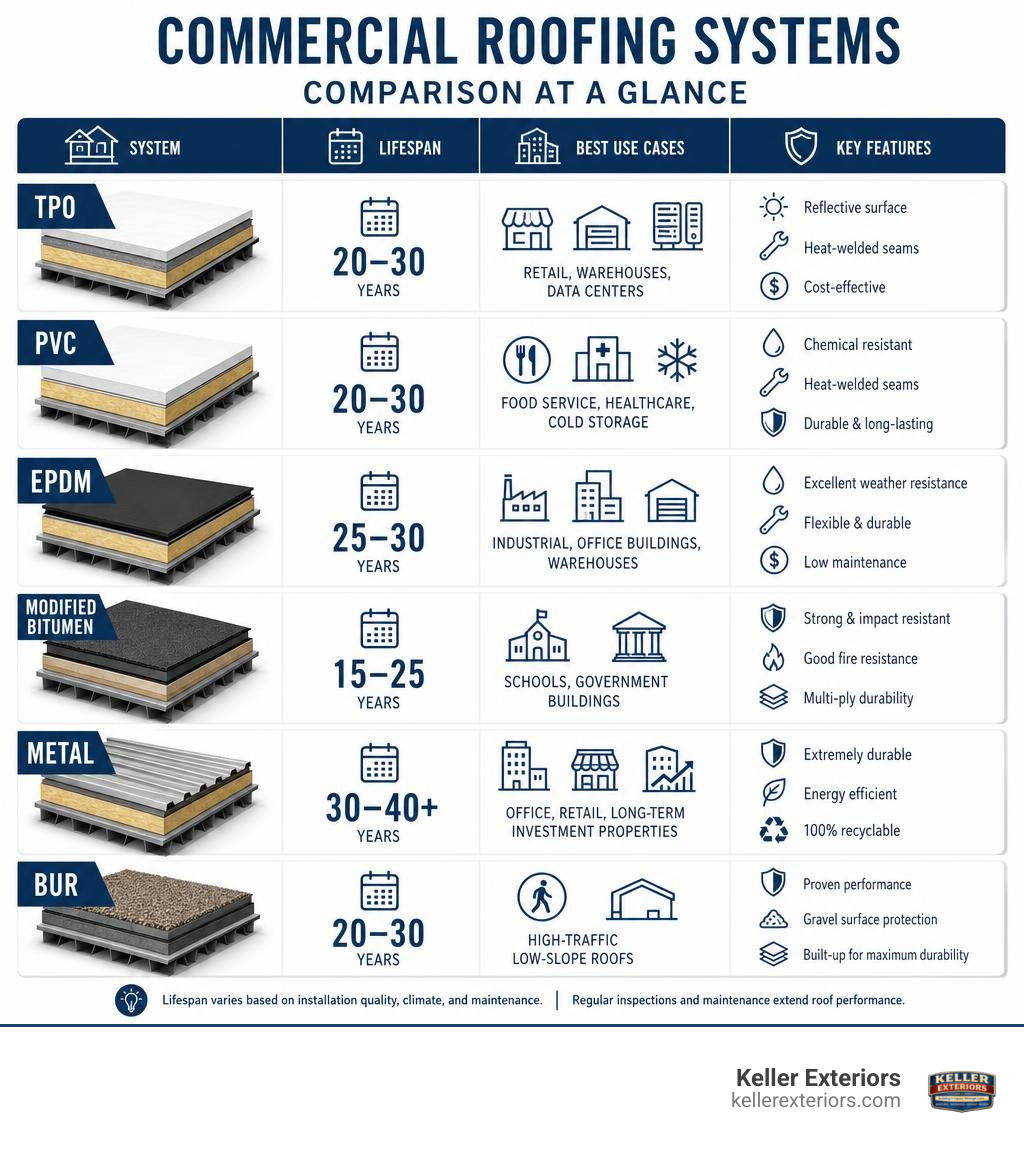
Here is a quick overview of the most common commercial roofing systems and what sets them apart:
| System | Typical Lifespan | Best For |
|---|---|---|
| TPO | 20-30 years | Retail, warehouses, data centers |
| PVC | 20-30 years | Food service, healthcare, cold storage |
| EPDM | 25-30 years | Industrial, office buildings, warehouses |
| Modified Bitumen | 15-25 years | Schools, government buildings |
| Metal | 30-40+ years | Office, retail, long-term investment properties |
| Built-Up Roofing (BUR) | 20-30 years | High-traffic low-slope roofs |
Most commercial roofs generally last 20 to 30 years, though that number depends heavily on the material you choose, how well it is installed, and how consistently it is maintained.
Every commercial roof is built around three core principles: keeping water out, providing structural reinforcement, and protecting the surface from the elements. Understanding how different systems handle each of these jobs helps you make a smarter decision for your building.
Whether you manage a warehouse, a retail center, or an office complex, this guide breaks down what you need to know in plain language, without the jargon.
At Keller Exteriors, our team brings more than 20 years of exterior-project experience to commercial roofing decisions throughout the Tulsa area. We help building owners compare materials, assess roof conditions, and plan for dependable long-term performance.
Core Components of a Commercial Roof
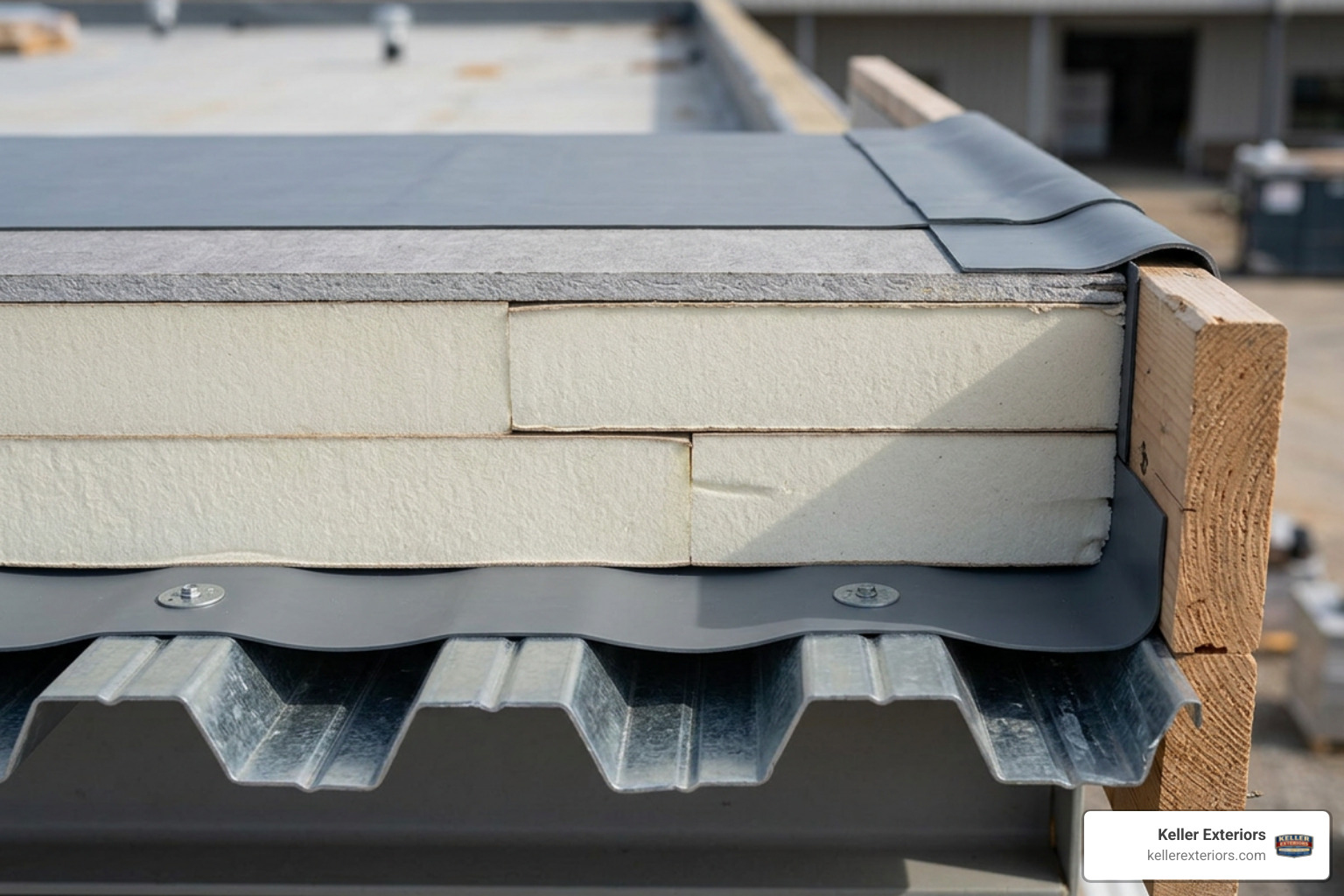
To understand how a commercial roof works, you have to look beneath the surface. A complete system is much more than the top membrane. It is a carefully engineered assembly of multiple layers working together to protect your building from water, wind, and temperature swings.
A professional commercial roofing evaluation helps identify whether the deck, insulation, cover board, membrane, and drainage details fit the structural needs of your property.
A typical low-slope commercial roof consists of several key layers:
- The Structural Deck: This is the foundation of the roof, usually made of steel, concrete, or wood. It supports the weight of all other roofing materials and seasonal loads, such as heavy snow or standing water.
- The Vapor Barrier: This layer helps prevent moisture from inside the building from rising into the insulation, where it could condense and cause rot or mold.
- Insulation: This layer controls heat transfer, helping keep your building warm in winter and cool in summer.
- The Cover Board: A thin, dense protective layer placed over the insulation to absorb impacts and provide a flat, rigid surface for the membrane.
- The Waterproofing Membrane: The primary shield against rain, snow, and UV rays.
- Surfacing: The final top layer that protects the membrane from physical damage and sun exposure. This can be gravel, a reflective coating, or mineral granules.
Weatherproofing and Reinforcement Layers
The weatherproofing layer is your roof’s first line of defense against the elements. In traditional multi-ply systems, this layer consists of several sheets bonded together.
The base sheet is secured directly to the substrate, providing a stable foundation. Above the base sheet, installers lay multiple interply sheets, bonding them with hot asphalt or cold adhesives. Finally, they apply a heavy-duty cap sheet to seal the system.
Reinforcement gives these sheets their strength. Without it, the waterproofing materials could crack and tear as the building shifts and temperatures change.
Manufacturers typically reinforce these membranes with either fiberglass or polyester. Fiberglass mats offer high tensile strength and dimensional stability, which helps keep the roof from stretching or shrinking.
Polyester mats offer superior elongation and puncture resistance, allowing the roof to flex and absorb impacts without tearing.
Insulation and Cover Boards
Insulation does more than lower utility bills. It also provides a flat surface for the rest of the roof assembly.
Polyisocyanurate, commonly called polyiso, is a common insulation material for low-slope roofs. It offers high thermal efficiency per inch of thickness, meaning you may need less material to meet building energy codes.
On top of the insulation, installers add cover boards. These dense panels protect the softer insulation underneath from physical damage.
When technicians walk on the roof to service HVAC units, or when severe weather strikes, cover boards distribute weight and absorb impact. This helps prevent membrane punctures and insulation compression that can reduce thermal efficiency.
Comparing Popular Commercial Roofing Systems
Choosing between different commercial roofing systems requires balancing performance, durability, and how you plan to use your building. Each material has distinct characteristics that make it a practical fit for specific applications.
Single-Ply Commercial Roofing Systems
Single-ply membranes are a common choice for modern commercial properties. These systems use one layer of thermoplastic or synthetic rubber membrane across the roof.
- TPO (Thermoplastic Polyolefin): TPO is popular for its reflective surface and practical performance. Light-colored sheets reflect solar heat, helping keep the building cooler and reducing AC demand. Installers heat-weld the seams to create a continuous, watertight bond.
- PVC (Polyvinyl Chloride): PVC is durable and resists fire, wind, chemicals, grease, and oils. It can be a strong option for restaurants, food-processing facilities, and buildings with exhaust that reaches the roof.
- EPDM (Ethylene Propylene Diene Monomer): EPDM is a synthetic rubber membrane known for durability. It handles significant temperature swings and resists UV damage well. Although it is often black and absorbs heat, EPDM remains flexible and is generally straightforward to repair.
Membrane thickness is a major factor in single-ply performance. Membranes generally range from 45 mils to 80 mils. A thicker membrane provides greater resistance to punctures, weathering, and physical wear over time.
Asphaltic and Metal Commercial Roofing Systems
For buildings that require heavy-duty, multi-layer protection, traditional asphaltic systems remain a reliable option.
- Built-Up Roofing (BUR): Often called “tar and gravel” roofs, BUR systems consist of alternating layers of asphalt and reinforcing fabrics. This redundant design means that even if the top layer is damaged, multiple layers underneath can continue to keep water out. BUR works well on high-traffic roofs because the gravel surfacing resists physical wear.
- Modified Bitumen: This system improves on traditional BUR by adding polymer modifiers to the asphalt. These modifiers give the material rubber-like elasticity or plastic-like toughness. Modified bitumen can be installed with hot asphalt, cold adhesives, heat-welding, or self-adhering sheets.
- Architectural Metal: Metal roofing is a long-lasting option. It requires a larger initial investment, but it can last more than 40 years with consistent maintenance. Metal panels resist high winds and shed rain and snow quickly, making them useful for sloped commercial structures.
Single-Ply Membranes vs. Multi-Ply Systems

When selecting a flat roof system, the biggest debate often centers on single-ply membranes versus multi-ply systems. Understanding the trade-offs in construction, weight, and durability will help you make the right choice.
Single-ply membranes are lightweight, quick to install, and highly reflective. Because they consist of a single sheet, they place less structural load on your building.
The heat-welded seams of TPO and PVC create a secure barrier against leaks. However, because there is only one layer, a sharp object can puncture the membrane all the way through the roof.
Multi-ply systems, such as BUR and modified bitumen, offer strong redundancy. They are thick, heavy, and highly resistant to punctures.
If a tool is dropped on a multi-ply roof, it may damage the top layer, but the layers below can still help prevent water from entering the building. The downside is that these systems are heavier, take longer to install, and do not offer the same level of solar reflectivity as light-colored single-ply membranes.
For a broader look at material decisions, our roof replacement options guide explains how roof design, durability expectations, and maintenance needs affect long-term planning.
While steep-slope buildings may use asphalt shingle roofing to shed water, low-slope commercial properties need specialized systems that can manage standing water and large structural spans.
Key Factors in Selecting a Commercial Roof
Selecting the right roof requires looking at your building as a whole, along with the local environment. Here are the key factors you must consider:
- Climate and Weather: In Oklahoma, roofs must endure intense summer heat, freezing winter temperatures, and severe spring storms. High winds exceeding 100 mph can threaten buildings in Tulsa, OK, Broken Arrow, OK, and Owasso, OK. Your roof needs verified wind-uplift resistance to withstand these storms.
- Building Design and Use: The slope of your roof, the weight it can support, and what happens inside the building all influence the best material choice. A building with heavy grease exhaust may need PVC, while a large warehouse in Bartlesville, OK, or Claremore, OK, may benefit from a reflective TPO system.
- Energy Efficiency: Reflective cool roofs help keep your building from absorbing solar heat. This can lower cooling costs and reduce strain on HVAC equipment.
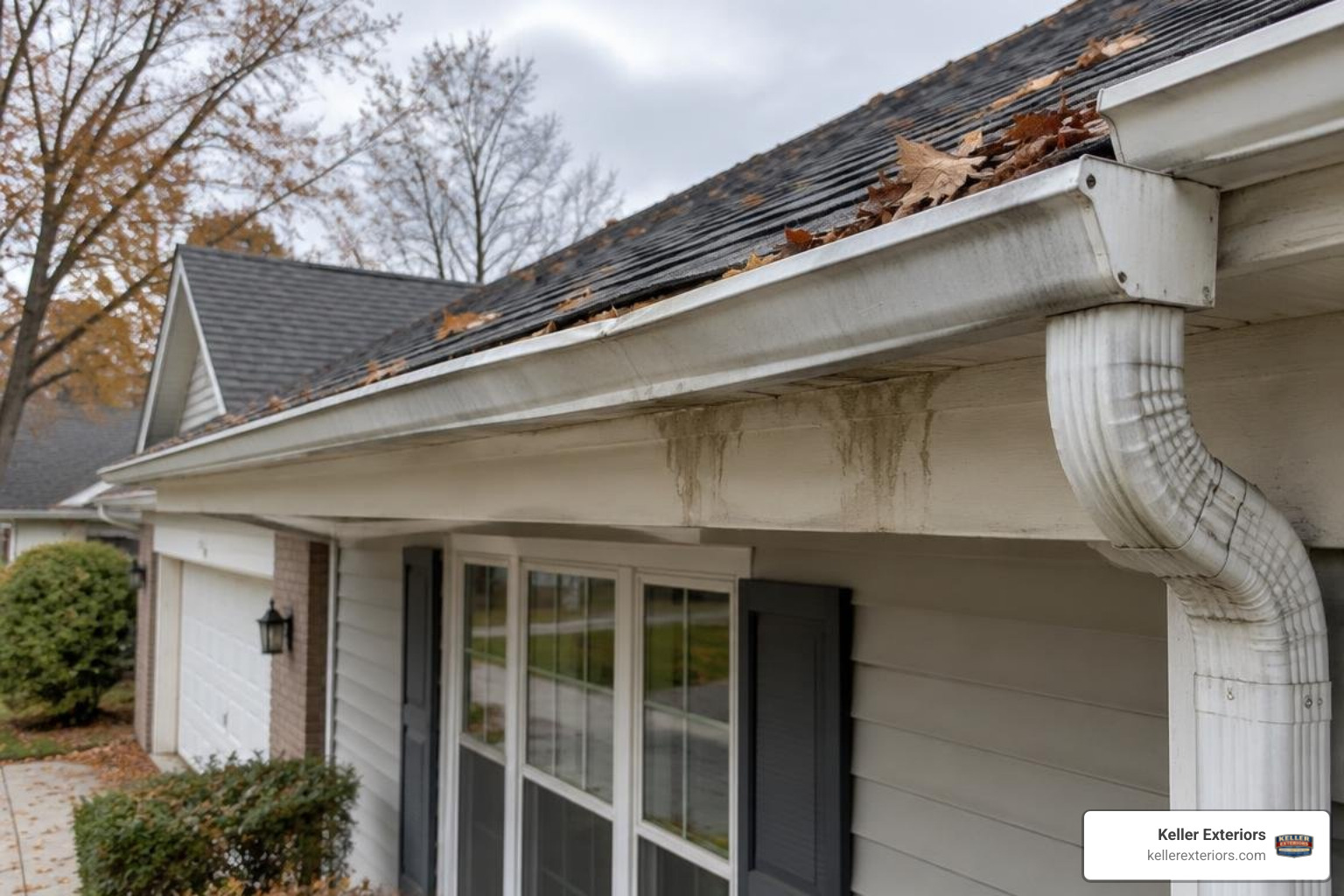
- Drainage: Standing water is the enemy of any low-slope roof. Your system must work with the building’s drainage design to direct water away efficiently.
When drainage issues contribute to pooling near roof edges, a properly designed gutter replacement project can help protect the building exterior and improve water management.
Extending Roof Lifespan with Coatings and Maintenance
You do not always have to tear off and replace an aging commercial roof. If the underlying structure and insulation are dry, you can often restore the roof using liquid-applied coatings.
Elastomeric coatings, made of silicone or acrylic, are sprayed or rolled directly onto an existing roof. They cure to form a seamless, flexible, waterproof membrane that seals minor leaks and restores UV protection.
Silicone coatings are useful for flat roofs because they resist standing water, while acrylic coatings can work well on sloped metal roofs to help prevent rust and reflect heat.
For early maintenance concerns, our roof patch and sealant guide covers the warning signs that call for prompt attention before a small issue spreads.
However, coatings are not a substitute for regular care. A consistent preventive maintenance program helps keep your warranty valid.
Many manufacturers require annual or twice-yearly inspections to maintain coverage. Clearing debris from drains, checking seam integrity, and repairing minor punctures early can prevent small issues from becoming major structural damage.
Frequently Asked Questions About Commercial Roofing Systems
What is the average lifespan of commercial roofing systems?
Most commercial roofs generally last 20 to 30 years. The exact lifespan depends on the material, with metal roofs lasting 40+ years, EPDM and TPO lasting 20 to 30 years, and modified bitumen lasting 15 to 25 years. Regular maintenance and professional installation are key to reaching these lifespans.
How do TPO and PVC commercial roofing systems differ?
While both are single-ply thermoplastic membranes, PVC offers much higher resistance to chemicals, grease, oils, and fire. TPO is highly reflective and typically more cost-effective, making it a popular choice for retail and warehouse spaces, while PVC is preferred for restaurants and manufacturing facilities.
What are the primary components of a low-slope commercial roof?
A low-slope roof consists of three primary layers: the weatherproofing layer to keep water out, the reinforcement layer to provide tensile strength, and the surfacing layer to protect the assembly from UV rays and physical impact.
How do roof coatings help extend the life of commercial roofing systems?
Liquid-applied coatings form a seamless, fully adhered barrier over your existing roof. This seals minor leaks, restores UV protection, and increases solar reflectivity, which can add 10 to 15 years to the roof’s life without the cost of a full tear-off.
What is the difference between SBS and APP modified bitumen?
SBS modified bitumen uses synthetic rubber modifiers to give the roof high elasticity, making it excellent at expanding and contracting in cold climates. APP modified bitumen uses plastic modifiers that make the material tough and highly resistant to UV damage, and it is typically applied using a torch-down method.
Why are cover boards important in commercial roofing systems?
Cover boards sit between the insulation and the roofing membrane. They provide vital structural support, distribute heavy foot traffic loads, protect the soft insulation from compression, and offer highly valuable puncture resistance and fire protection.
How does wind resistance affect commercial roofing systems in storm-prone areas?
High winds create upward pressure, known as wind uplift, which can pull a roof membrane away from the building. In storm-prone areas like Oklahoma, roofs must be engineered with specific mechanical fastening or fully adhered patterns to resist these forces.
What are the benefits of a fully adhered TPO system?
A fully adhered TPO system uses specialized bonding adhesives to attach the membrane to the cover board. This eliminates membrane fluttering in high winds, reduces air intrusion, limits thermal bridging, and provides a flat, smooth, and highly attractive appearance.
How do building owners maintain warranty compliance for commercial roofing systems?
To keep a commercial roof warranty valid, building owners must perform regular, documented roof inspections, clear debris from drains, and hire certified commercial contractors to perform any necessary repairs using approved materials.
When should a commercial roof be restored versus completely replaced?
A roof is a good candidate for restoration if the insulation is dry, the seams are mostly intact, and the overall structure is sound. If core cuts reveal trapped moisture, or if more than 25% of the roof is damaged, a complete replacement is usually necessary.
Partner with Local Exterior Experts for Long-Term Performance
Your commercial roof is a major investment that protects your business, tenants, and assets. Choosing the right materials and the right installation team makes a meaningful difference in long-term building performance.
At Keller Exteriors, our team brings more than 20 years of local exterior experience to commercial projects across Oklahoma, serving property owners in Tulsa, OK, Broken Arrow, OK, Owasso, OK, Jenks, OK, Bixby, OK, and nearby communities.
We understand the demands of the local climate, from intense summer heat to severe spring storms. Our team provides straightforward guidance, quality craftsmanship, and reliable maintenance support to help keep your building secure.
Whether you need a comprehensive roof inspection, a targeted repair, a protective coating, or a complete system replacement, Keller Exteriors is ready to help. Contact our commercial roofing specialists to discuss the right next step for your property.