
Most gutter problems trace back to one thing: seams. Every joint in a sectional gutter system is a potential failure point, and Tulsa’s spring storms, temperature swings, and wind-driven debris accelerate the damage those seams cause over time. Seamless gutters eliminate the problem at the source. A single continuous channel runs from corner to corner with no mid-run joints, no sealant to crack, and no gaps to collect debris and corrode.
Keller Home Enhancements fabricates seamless gutters on-site at every job. That means the system is cut to the exact dimensions of your home, not trimmed to fit from a standard length. The result is a cleaner profile, a more secure attachment, and a drainage system built specifically for your roofline.
We have served Tulsa homeowners since 2001 and bring 25 years of local experience to every installation. Request a Free Consultation or call 918-800-9727 to schedule yours.

Tulsa homeowners switching from sectional to seamless systems usually arrive at that decision after recognizing a pattern that cleaning and patching cannot resolve. These are the most common triggers:
Understanding what causes sectional gutters to fail helps explain why seamless gutter installation delivers better long-term results in Tulsa’s climate. The failure modes are consistent and predictable.
Sectional gutters fail because of how they are built and where they are installed:
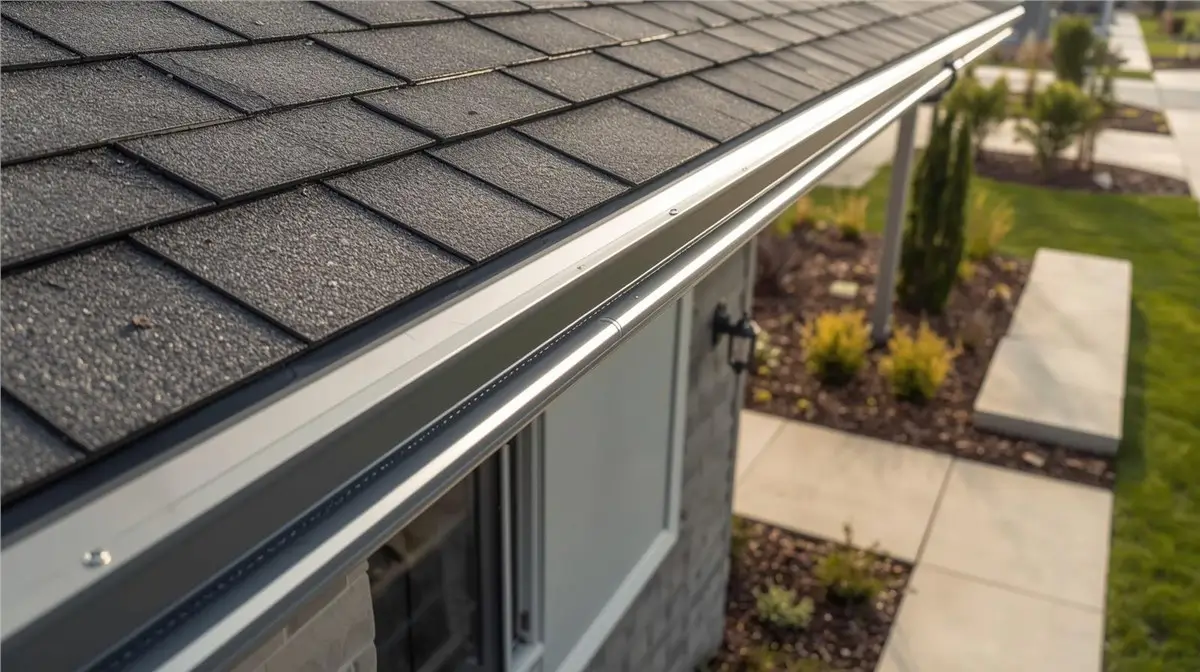
Keller Home Enhancements approaches every seamless gutter installation with a measurement-first process. Our technicians are highly trained and certified and take precise measurements of every gutter run, fascia condition, roof pitch, and downspout location before fabrication begins.
We maintain a fully stocked warehouse and bring mobile fabrication equipment to each job site. Every channel is formed on-site from coiled aluminum stock to the exact length your home requires. Nothing is trimmed from a longer section, and no seams are added to make a standard length fit.
Before recommending seamless gutters over repair, our team evaluates whether isolated sections of an existing system can be preserved. We do not recommend full replacement when targeted repairs will restore the system to reliable function. When seamless installation is the right answer, we explain why and present upfront pricing before any work begins.

K-style aluminum seamless gutters in 5-inch and 6-inch widths, with 6-inch profiles recommended for larger roof areas and Tulsa's higher-intensity storm events
Half-round seamless profiles for historic, craftsman, and colonial-style homes in established Tulsa neighborhoods where the round profile matches original architectural details
Copper seamless gutters for homeowners prioritizing longevity and a distinctive appearance that ages naturally over decades
Steel seamless profiles for applications requiring added structural strength, particularly on homes with steep pitches or unusually long gutter runs
Matching downspouts, elbows, and underground drainage extensions fabricated and installed as part of the complete system
Gutter guard systems that integrate directly with the seamless profile for a finished appearance and reduced maintenance load

A gutter replacement done incorrectly can leave a home worse off than the failing system it replaced. Pitch errors, undersized downspouts, and improper hanger spacing all produce the same water control failures as the old gutters, sometimes faster.
Professional installation matters for specific reasons:

Twenty-five years of seamless gutter installation across Tulsa’s diverse housing stock has given our team direct experience with every roof type, drainage pattern, and neighborhood condition in the metro.
In Midtown and Brookside, homes built from the 1940s through the 1970s typically have original or once-replaced sectional systems with gutter profiles smaller than what the roof area actually requires. These homes also carry the widest fascia boards in the metro, which allows for a clean seamless installation when the fascia is in good condition.
In Broken Arrow, Owasso, and Catoosa, newer construction often used 4-inch or undersized 5-inch profiles on homes with large roof areas. Our team sizes the replacement correctly, typically stepping up to a 6-inch K-style profile to handle the volume these roofs generate during Tulsa’s spring storm peak.
In communities like Forest Ridge, Stone Canyon, and Indian Springs, heavy tree canopy makes gutter guard integration at the time of seamless installation a strong investment. Tulsa’s fall debris load fills unprotected gutters within weeks in these neighborhoods, and combining the new system with guards from day one eliminates that cycle.

Your roof, windows, siding, and doors all take a beating from Oklahoma weather. Keller Exteriors gives Tulsa homeowners a single, trusted team to handle every exterior project with skill, honesty, and care.
We have been doing this work since 2001 because we believe your home deserves to be great, and so does the experience of getting there.


or
Seamless gutters eliminate the seam problem, but they do not self-install correctly. The performance advantage of a continuous channel disappears if the system is pitched wrong, hung at the wrong spacing, or routed with downspouts too close to the structure.
Professional installation protects against specific failure modes:
A correctly installed seamless system protects the foundation, fascia, soffit, and landscaping for decades. A poorly installed one fails for the same reasons the sectional system it replaced did, just without visible seams to blame.
Sectional gutters are assembled from pre-cut lengths joined at overlapping seams filled with sealant. Every seam is a potential failure point that expands and contracts with temperature changes and eventually allows water to escape. Seamless gutters are fabricated as a single continuous channel from one end to the other with no mid-run joints. The only seams in a seamless system are at inside and outside corners and at the end caps, which are minimal compared to a sectional system.
Resealing works when a seam has failed in one location and the surrounding material is structurally sound. When multiple seams across the gutter line are failing simultaneously, the underlying cause is usually the age and condition of the material itself, not isolated sealant failure. Resealing every joint on an old sectional system produces a short-term result because the material around each joint continues to degrade. Replacing the system with seamless gutters removes the recurring seam maintenance cycle entirely.
The correct size depends on the roof’s square footage, pitch, and the drainage rate required for Tulsa’s storm intensity. Most residential roofs in the Tulsa metro are served well by 5-inch K-style gutters, but homes with larger roof areas, steeper pitches, or rooflines that concentrate runoff from multiple planes into a single gutter run often need 6-inch channels to handle peak flow without overflowing. Our team measures and calculates the right profile at the time of consultation.
Corner overflow typically points to one of three causes: debris concentration at inside corners blocking flow, a mitered corner joint that has separated and is losing water before it reaches the downspout, or a gutter run pitched toward the corner rather than toward a downspout. In seamless gutter systems, corner sections are formed and sealed precisely at installation to reduce the gap that sectional corner joints create. If your sectional system overflows consistently at corners, that is often the first visible signal that seam integrity has declined across the whole system.
We start with a full measurement of every gutter run, fascia board, roof pitch, and downspout location. That data goes directly into the fabrication process so the channels produced match your home exactly. Gutters are formed on-site from aluminum coil stock, installed with hangers at the correct spacing, and pitched for positive drainage before we leave. The full process from arrival to completion typically runs one day for most Tulsa residential projects. Learn more on our seamless gutter installation page.
A standard Tulsa residential installation runs four to eight hours depending on the home’s perimeter, number of stories, and any fascia preparation needed before gutters are hung. Homes requiring fascia board repair or replacement before installation add time to the project, which we identify and price during the initial inspection. We confirm the schedule and timeline before work begins so there are no surprises on installation day.
Installing gutter guards at the same time as new seamless gutters is the most cost-effective approach if your property has significant tree coverage. Tulsa neighborhoods with mature landscaping can fill unprotected gutters with debris within a few weeks during fall and spring. Combining the installation eliminates a separate service visit and ensures the guard system integrates cleanly with the new gutter profile. For homes with minimal tree exposure, guards are optional and can be added later.
Cleaning seamless gutters at least once a year removes debris before it compacts and adds load to hangers. In Tulsa neighborhoods with significant tree canopy, twice-yearly cleaning in spring and fall keeps the system performing through storm season. Checking the hanger attachment and end caps every few years catches any loosening early. Because seamless gutters have no mid-run seams to monitor, the maintenance routine is simpler than with sectional systems and focuses mainly on keeping the channel clear and the downspouts unobstructed.